Loser mentality
A story about weight loss and life. And a life of weight loss.
Here's a fun fact: for the first 25 or so years of my life, I don't actually really know how much I weighed. I can ballpark it, sure, and there's the number that showed up whenever I went to the doctor (but we can't trust those ones, can we?) (and given I visited our family doctor after I turned 16, getting weighed in or taking blood pressure wasn't generally the formality it's become since I became an actual adult), but for my entire time living with my father, there were only two scales that we used in our house. The first was a Health O Meter beam scale that was constantly out of calibration and – according to the other members of my family – notoriously unreliable even when you were able to tweak the rubber balance to get the needle to float level before you stepped on it. The second scale in my house was even more hilarious: a turn-of-the-(20th)century carnival scale that was operated by dropping a penny into it. The carnival scale, make no mistake, was extremely cool, but if anything it was even more of a crap shoot than the Health O Meter. You could sometimes step off and step on after using one penny and get two drastically different weights, or could step off, wait for it to reset, drop a new penny in, and ... get two drastically different weights. So up through community college, I really only have a general ballpark idea of how much I weighed.
I was picked on from about the first or second grade on for being a "fat kid," but when I look at old photos of me, I wasn't anywhere near a fat kid. Not until I got into junior high, anyway. But the social stigma was there from elementary school, and as the son of a notably fat man, it was tough to ignore – both from my perspective, and the perspective of my peers. At the end of eighth grade, I weighed in the ballpark of 270 pounds ... or maybe 230, or 250. 270 tends to be the weight I remember, but who knows where that number came from. I was certainly very heavy heading into my sophomore year of high school, the year that I foolishly believed I might want to try playing football and only lasted into the second week of two-a-days before admitting to myself and the coach that I was having zero fun.
My junior year into my senior year was the first major weight loss period of my life. I shed a ton of weight in those two years, and it was almost entirely from dancing. I would turn on music in my living room at night and just move for hours at a time, sweating buckets and feeling fantastic. At some point during my senior year, I weighed in at 218 on the Health O Meter. I felt thin, and people told me I looked great. I felt great. Confident. There was a chart on the carnival scale that displayed how much men and women should weigh, based on their height. The chart said that at my height of 6'2", I should weigh 181 pounds. I assumed this was woefully out of date, since the scale was manufactured in 1890 or some such, and I felt about as thin as I could possibly be. Since then, I've always assumed that it would look bizarre if I weighed that little.
During my college years, I began gaining weight again. At one point, my best friend told me he was concerned about my weight, so I changed my eating habits and began running. Eventually, he and I began running together, especially when he lived at my father's house in a spare room in the garage. I started running between four and eight miles every single day, and I felt terrific. If I wasn't in the best shape of my life, I was close. But I developed achilles tendonitis, and running became excruciating. I stopped running, and I began gaining weight again.
Circa 2007 to 2009, I lived in San Jose with two close friends, and we all became hyper-fixated on working out. We rode bikes several miles to the gym every day, where we lifted heavy. We switched to protein-rich diets and took supplements, focusing on building muscle while making sure to get in cardio (mostly via the bike riding, but often with cardio at the gym as well). Eventually we went to the gym twice every day: driving in the early morning before we all went to work, biking in the evening when we finished work. This was the first time I owned a reliable scale and weighed myself regularly. I got down to 240 pounds, but had the most muscle of my life. I felt great, but I still couldn't come close to keeping up with my friends when they went for actual bike rides or rode hills. I started assuming that 240 was where I should live; that it was a good weight for me, personally.
I got laid off in 2009 and moved to Los Angeles, and I was unemployed for two years. When I stumbled into a job as a sportswriter, I started working up to 60 and sometimes 80 hours a week, sitting at my computer. Exercise wasn't a priority for me, and I began gaining weight again. A couple years later I started going back to the gym, then started running again, off and on. I ran my first official 5K, and caught the running bug once more. Then I got engaged, and began working hard to lose weight before my wedding. When I got married in 2015, I weighed in just a shade under 240. I had hit what I thought was my ideal weight. A couple months later, on my honeymoon, I really fell off the "eating healthy" wagon and gained a bunch of weight in an astonishingly short time. Somehow, I was running more than I ever had, and was training for a half marathon in 2016. In November 2016, I ran the RunDisney Infinity Gauntlet Challenge, which was a 5K and a half marathon on back-to-back days. I was possibly in the best running shape of my life, and until very recently, I remembered myself as being in good shape in general at that time. Looking back at the photos and at my weight loss app, I was definitely not at a good weight. I definitely weighed over 260, and most likely weighed over 270 at that time.
Let me just say now – and I probably should have said up top – that I absolutely believe in "healthy at any size," and that every person should definitely do what is right for them and for their life. I was definitely healthy in 2016, despite my weight, but I understand I should have been doing some things differently.
From 2016 to 2018, I was in a job that torpedoed my mental health, and that took a definite toll on my mental health. I stopped running again by the time I was laid off from that job, and hit 290 in March of 2018. I started a new job at Fox Sports which came with a commute – something I hadn't had to deal with in years. I began trying to lose weight in August, and by December 2018 had gotten down to 262. Not a single person mentioned noticing any weight loss, and dropping about 30 pounds didn't feel like much of an accomplishment, so I began gaining again.
In the past couple of years, I've genuinely been trying to lose weight again, and since I'd gone through so many instances of losing 30, 50, 70 pounds, I assumed I could just do it again if I put my mind to it. As it turns out, "putting my mind to it" is no longer as simple as putting my mind to it in my mid-40s. I started working out every day, and I watched what I ate, but it wasn't enough. My doctor prescribed GLP-1 medication, but my insurance refused to cover it. I struggled through those years not seeing any results, and actually seeing the scale hit 300 pounds for the first time in my life – although I'm sure I must have topped that at some points in my life prior. I saw all the great results many of my friends were having on Zepbound and similar medication, and their insurance companies were paying for it, to boot.
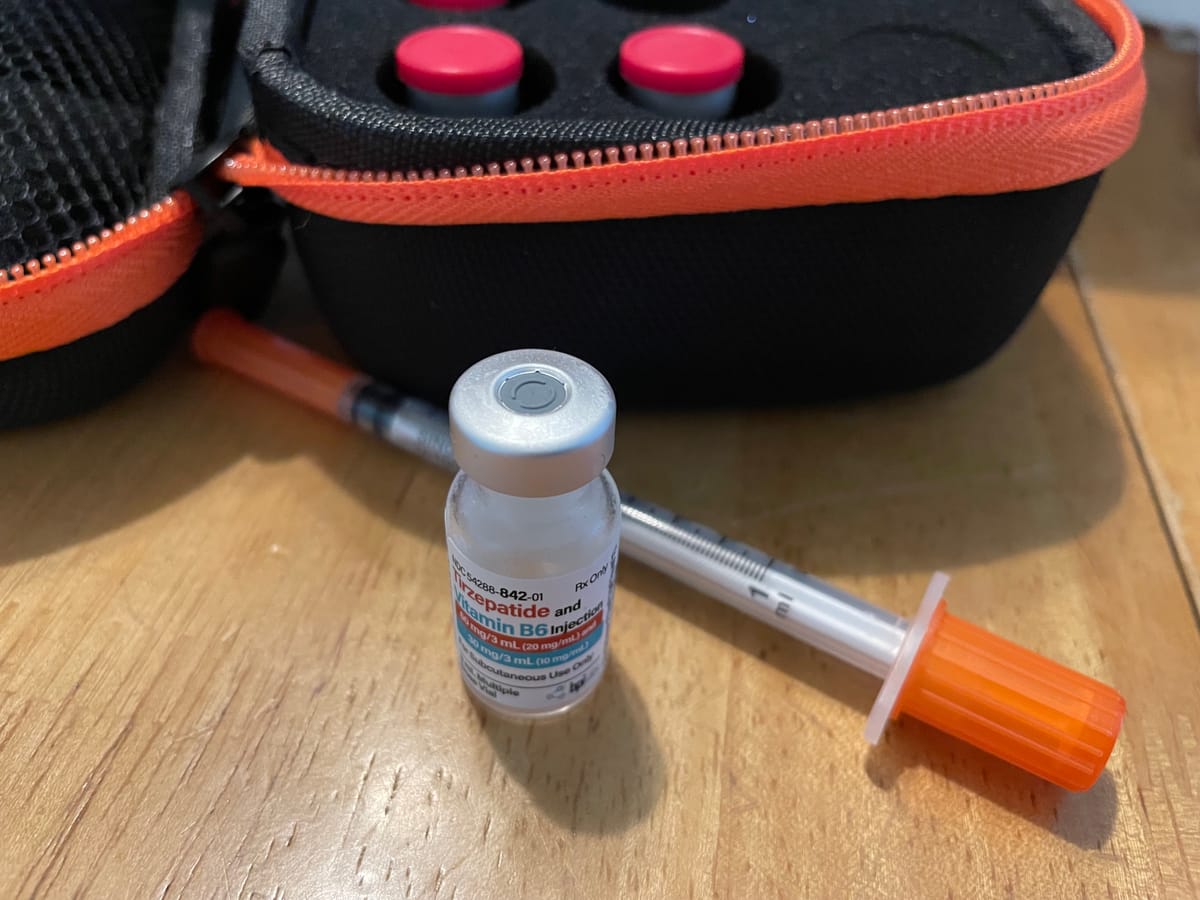
In the past couple of years, a bevy of online pharmacies have been working with compounding labs who have been making compounds of the GLP and GIP medications, which allows them to sell versions of the Big Pharma medications like Zepbound, Wegovy, Ozempic and Mounjaro with vitamins added. Said online pharmacies offer multi-month prescriptions for a fraction of the price of the name-brand drugs I would have had to pay full price for if I left it in the hands of my insurance company. In June (the day after Father's Day, in fact), I started injecting tirzepatide (the side of the GLP/GIP tree that includes Zepbound and Mounjaro) once a week.
The drug doesn't make you lose weight. It isn't magic. What it does is increase feelings of satiety and "fullness," but I'd been hearing that various supplements were supposed to do those things since Herbalife was a thing back in like 1999. The main thing it does – for me, at least – is to reduce "food noise," which manifests as intrusive thoughts about food, or turning to eating something when I'm bored or stressed or depressed. By reducing the food noise so significantly, it makes it feel as if I have more willpower. And that part does sometimes feel like magic. But it requires the legwork on my end. Literally!
I've been working out for an hour a day since May, and I started running again. I ran my first timed race since New Year's Day 2019. (My time was terrible.) I've been running two to three times a week, building back up. I'm thinking about doing another half marathon again. I'm thinking about maybe doing a marathon for the first time.
Last week, I weighed in under 218 for the first time since high school (if that weight was ever accurate in the first place). I feel so much better than I did before I started this most recent weight loss. With this last milestone, I've now hit my first three or four goals. But I've got two more: the first is that I want to weigh under 200 pounds for the first time in my adult life, and the second is that I want to get around 185 pounds, to see if that carnival scale was full of shit or not. I have no idea if I'll hit either goal, but my most important goal is this: to never let myself get over 250 again for the rest of my life. Just for my own personal health and wellbeing and comfort level. I feel like I can actually accomplish this now that I understand what it takes and how to mentally calibrate myself.
The other massive component of all of this – beyond "healthy at any weight," which I still believe is the most important part – is that I have body dysmorphia. I understand and can recognize that I look and feel massively different than I did just a year ago, but when I look in the mirror, I see the exact same person at 218 that I did at 290. I look at photos and am shocked and proud and impressed, but all of this is compounded by the fact that for so long, I had no idea how much I weighed, and for some reason – even now – it seems as if I took almost no photos of myself during my thinnest periods over the course of my life. Part of this is, of course, because I am so frightfully old that big stretches of that time only included photos on actual film, and other stretches of digital photos never made it to present day. There were no apps or camera photos to track weights or keep photos from one device to the next. BACK IN MY DAY YOU LOST WEIGHT IN A NOTEBOOK, YOU UNGRATEFUL KIDS.
I'm grateful for everything I've gone through and everything I've learned, and I want to stress that if you feel like you need to make a change, you should give it a shot. If you feel like you need help with that, whether it be in the form of medication or anything else, you have absolutely nothing to lose. Some people get really awful side effects on these drugs. Luckily, I mostly didn't. If you respond poorly to the medication, you can just stop. It's worth a shot (no pun intended) if you can afford it and if you think you can benefit from it.
I know extremely well how difficult it can be to start your fitness journey, and how hard it is to keep your willpower and enthusiasm for that journey. They're two extremely finite resources. I've known a lot about how to lose weight for a very long time. It's nice to finally be able to put it all together. I have a long way to go, and an even longer way to go to maintain it all, but I'm on the right track.
Remind me to talk to you all about running sometime.